
ROLE
UX Designer
DURATION
20 Weeks
TEAM
5 Designers
ORGANIZATION
Caterpillar × DePaul University
FOCUS
Enterprise UX • Systems Design • Identity
SCROLL TO EXPLORE
“Operators measured every second before starting work. Caterpillar measured every operator behind the controls.”
Designing for one without compromising the other became the defining challenge of the project.
To understand the problem, we first had to understand the people behind the machines.
RESEARCH
Before exploring solutions, we needed to understand why existing Operator ID systems struggled with adoption. Through stakeholder interviews, workflow analysis, and competitive research, we discovered that the biggest barriers weren’t technical but behavioral.
01
Startup is a race against time
“We’ve got about ten minutes before work begins.”
Operators follow a fast, highly structured startup routine. Authentication competed directly with machine preparation, making every additional step feel like friction rather than value.
02
Complexity creates avoidance
“If they get lost, they bail.”
When authentication required too much attention or introduced uncertainty, operators simply avoided it. The issue wasn’t remembering credentials but protecting their workflow from unnecessary interruptions.
03
Identity offered little value
“It’s definitely gonna be tracking me.”
The system created value for Caterpillar long before it created value for operators. Without a clear personal benefit, operators had little reason to adopt the experience consistently.
Time
→
Trust
→
Value
Taken together, these findings revealed that authentication wasn’t failing because it was difficult. It was failing because operators didn’t see enough value to change their behavior.
Research didn’t just reveal usability issues.
It mainly challenged the question we were trying to answer.
THE TURNING POINT
We began by asking:
How do we make login easier?
↓
Research changed that question.
↓
We started asking something bigger.
Login should earn its place.
Authentication should support the operator’s workflow instead of interrupting it.
Identity should travel.
Operator identity should move seamlessly between machines rather than remaining tied to individual equipment.
Value drives adoption.
When authentication provides immediate benefits to operators, participation becomes a natural part of the workflow instead of another requirement.
We didn’t redesign authentication.
That shift in perspective became the foundation for everything we designed next.
SYSTEM DESIGN
Designing a Portable Identity System
Instead of redesigning a single login flow, we designed a portable identity system that could move with operators across machines, environments, and workflows. Every interaction was guided by one objective: authentication should become a natural extension of work rather than an interruption to it.
Portable identity architecture
Operator
│
▼
Bluetooth Detection
│
▼
Badge Confirmation
│
▼
Identity Verified
▼
Machine Profile
Personalized Experience
▼
Cloud Identity
Session Sync & Permissions
▼
Ready to Work
Portable Identity
Identity follows the operator instead of remaining attached to one machine.
Bluetooth and badge confirmation reduce repetitive manual interactions.
Cached identities keep operators productive even without connectivity.
Permissions and activity remain synchronized across the Caterpillar ecosystem.
Designed for Real Job Sites
Interactions remain usable while wearing protective equipment.
Authentication continues even when network access is unreliable.
Multiple operators can securely move between machines throughout the day.
Authentication never delays critical work.
Every part of the system answered the same question:
How can identity create value before asking for effort?
With the system defined, the next challenge became choosing the right technologies to bring it to life.
EXPLORING SOLUTIONS
Finding the Right Balance
Designing a portable identity system wasn’t simply about choosing a technology. Each approach solved one problem while introducing another. Our goal was to find the balance between usability, security, scalability, and real-world practicality.
RFID
Ease of Use — Medium
Security — Medium
Scalability — Medium
Hardware Requirements — High
Enterprise Readiness — Medium
NFC
Ease of Use — High
Security — High
Scalability — Medium
Hardware Requirements — Medium
Enterprise Readiness — High
Bluetooth + Badge
SELECTED DIRECTION
Ease of Use — High
Security — High
Scalability — High
Hardware Requirements — Low
Enterprise Readiness — High
FUTURE OPPORTUNITY
Ease of Use — High
Security — High
Scalability — Medium
Hardware Requirements — High
Enterprise Readiness — Emerging
Security
▲
Ease ◄
Bluetooth + Badge
► Scalability
▼
Operational Practicality
Why Bluetooth?
Automatic proximity detection reduces unnecessary manual interaction.
Why Badge Confirmation?
A deliberate confirmation step maintains accountability while preventing accidental authentication.
Why Not Biometrics?
While biometrics offer compelling long-term possibilities, current construction environments introduce practical challenges including gloves, dust, weather exposure, and hardware constraints.
The technology wasn’t the innovation.
The way identity moved through the system was.
With the system and technology defined, the next step was designing how operators would actually experience it.
EXPERIENCE DESIGN
Bringing the System to Life
The system was only successful if operators barely noticed it. Every interaction was designed to reduce friction while preserving trust, accountability, and operational continuity.
RETURNING OPERATOR
Operator Approaches Machine
↓
Bluetooth Detection
↓
Badge Confirmation
↓
Preferences Load
↓
Ready to Work

NEW OPERATOR
GUEST OPERATOR
BEFORE
Operator
↓
Login
↓
Machine Starts
AFTER
Operator
↓
Machine Detects
↓
Identity Restored
↓
Ready

Authentication became invisible.
Designing the experience was only part of the challenge. Every interaction also required deliberate tradeoffs.
FINAL EXPERIENCE
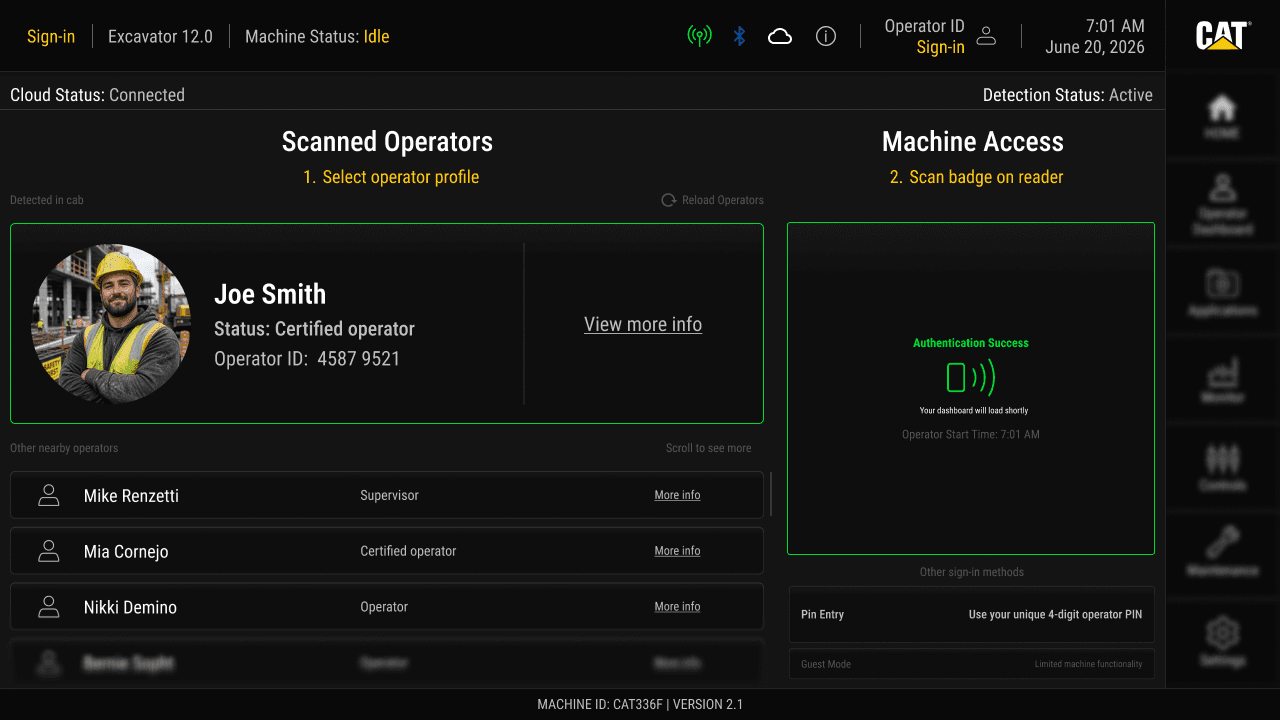
The system made the experience possible. These screens show what that looked like for operators in the field.

Returning Operator
AUTHENTICATION
One intentional action instead of repeated logins.
Bluetooth detects the operator. A badge confirms identity before loading the session.
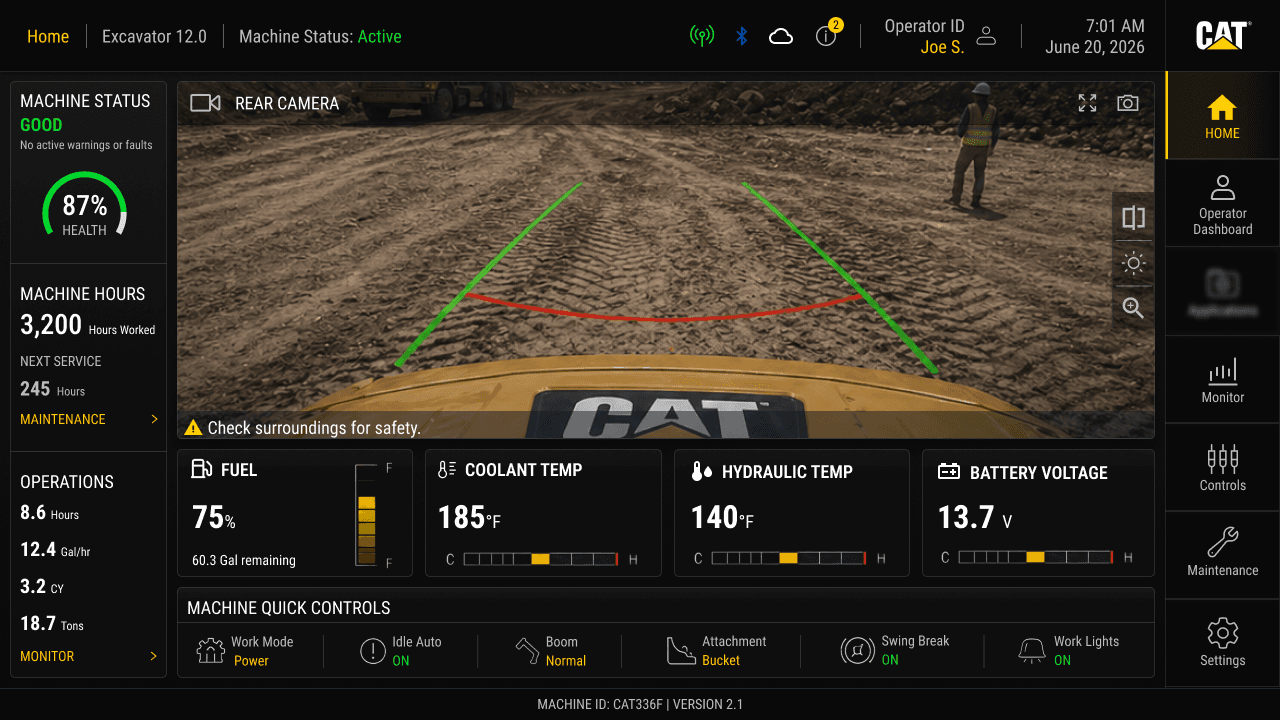
MACHINE PREFERENCES
The machine feels familiar every time.
Preferences, permissions, and settings return automatically after authentication.
END OF SESSION
The work ends. The identity doesn’t.
Session information is saved automatically so the next interaction starts where the last one ended.
BEFORE
Login
Wait
Configure
Start
AFTER
Approach
Confirm
Work
The goal wasn’t to redesign login.
It was to make getting to work feel effortless.
In hindsight, the biggest takeaway wasn’t the technology we chose. It was how research changed the direction of the project.
INTERACTIVE PROTOTYPE
Reading about the system is one thing. Interacting with it tells a much better story.
Explore the authentication flow from the operator’s perspective.
Building the prototype confirmed something we hadn’t expected.
REFLECTION
Looking Back
This project started as an authentication problem. It ended up changing how I think about enterprise design.
Research should change the question.
The biggest breakthrough wasn’t validating our assumptions. It was when we realized we were solving the wrong problem. That shift completely changed the direction of the project.
Systems shape experiences.
The interface was only one part of the solution. Designing how identity, machines, and people worked together had a much greater impact than any individual screen.
Adoption has to be earned.
People rarely embrace new systems simply because they’re available. They adopt them when those systems make everyday work noticeably easier.
— CLOSING
Thanks for reading.
Interested in seeing a different side of my work?
