
ROLE
UX Research • Product Design • Interaction Design
DURATION
10 Weeks
TEAM
Individual
METHODS
Interviews • Value Sensitive Design • Prototyping • Figma Make
FOCUS
Behavioral Design • Shared Living • Product Strategy
SCROLL TO EXPLORE
THE REAL PROBLEM
After interviewing 14 roommates, I realized the challenge wasn’t remembering chores. Conflict started much earlier, when people brought different expectations into the same home.
Roommate Interviews
Recurring Themes
Shared Problem
Unspoken expectations
Different ideas about cleanliness, guests, and shared spaces often created tension before anyone named it.
Communication avoidance
Most people postponed difficult conversations because they didn’t want to make home feel awkward.
Uneven responsibility
A clear pattern emerged: people often felt they were carrying more, even when nobody meant to be unfair.
Shared expenses
Everyday purchases created more confusion than rent because shared expectations were rarely explicit.
Expectations
Communication
Responsibility
Conflict
DESIGN FRAMEWORK
After interviewing 14 roommates, I realized I wasn’t designing a better chore app. I was designing for the relationships behind it. Conversations about chores were really conversations about trust, fairness, and shared expectations. At that point, usability alone didn’t feel like enough.
I chose Value Sensitive Design because it gave me a way to make product decisions around the people and relationships affected by them—not just the tasks on a screen.
Conceptual Investigation
Understanding the values involved.
Empirical Investigation
Learning from real roommate experiences through interviews and research.
Technical Investigation
Designing product features that support those values.
Traditional product thinking
What feature should we build?
How do we improve efficiency?
How do we automate this task?
My approach
What value should this feature protect?
How does this affect relationships?
What tradeoffs are we introducing?
DESIGN PRINCIPLES
Once the research was in focus, I stopped asking which features to build first. The harder question was which values the product needed to protect when roommates’ needs pulled in different directions.
Fairness
Help roommates feel responsibilities are shared equitably.
Trust
Encourage openness without creating unnecessary surveillance.
Transparency
Make expectations and responsibilities visible before conflict begins.
Shared Living
Autonomy
Give roommates flexibility instead of rigid rules.
Communication
Support healthy conversations rather than replacing them.
FROM PRINCIPLES TO PRODUCT
Once the values were clear, designing features became much simpler. Instead of asking what functionality the app needed, I started asking how each interaction could reinforce trust, fairness, communication, or autonomy. Every feature had to earn its place by supporting the relationships behind the product—not just the tasks.
THE PRODUCT
Coho wasn’t designed to remind roommates to do chores. It was designed to make expectations clearer before they turned into conflict. Every feature exists to make shared living feel a little more transparent, collaborative, and predictable.

Balance responsibilities over time instead of assigning permanent ownership.
Give roommates one place to coordinate routines, reservations, and shared spaces.

Agreements stay visible so everyone works from the same expectations.
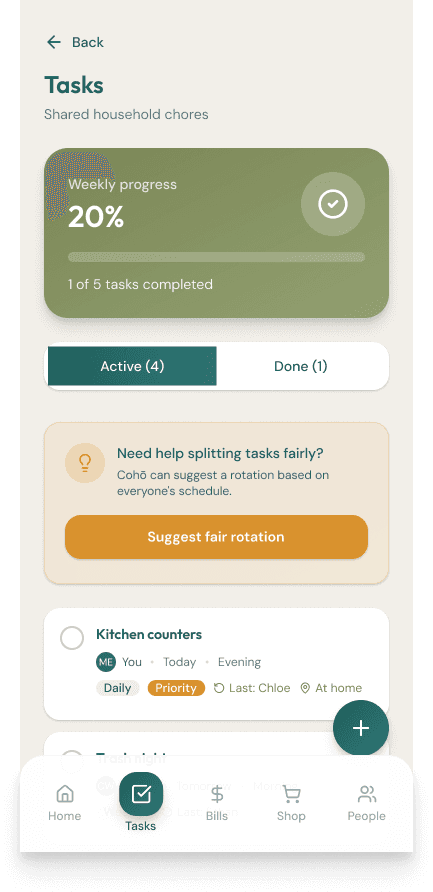
Responsibilities rotate naturally instead of assigning permanent ownership.
Progress is visible without turning chores into scorekeeping.
Fairness becomes a shared rhythm rather than a manual negotiation.
Shared purchases remain transparent from the beginning.
Splitting costs feels collaborative instead of transactional.
Visibility reduces confusion before it becomes conflict.

Shared spaces stay predictable for everyone.
Reservations coordinate routines without constant messaging.
Availability is visible at a glance.

THE COMPLETE EXPERIENCE
Each feature solves a different challenge of shared living. Together, they create a single experience built around clarity, fairness, and communication instead of constant coordination.
INTERACTIVE PROTOTYPE
Static screens only tell part of the story. The prototype brings the experience together by showing how roommates move through shared agreements, rotating chores, expenses, and household coordination as one connected product.
Open Prototype in Figma ↗
Shared Agreements
Establish expectations together.
Rotating Chores
Balance responsibility over time.
Shared Expenses
Keep household costs transparent.
Shared Coordination
Plan shared spaces with less friction.
— CLOSING
Thanks for reading.
Interested in seeing a different side of my work?
